
Tokyo Stroll Supplement: Haneda Shichifuku Inari Meguri / Haneda Seven Lucky Inari Pilgrimage
For information on Tokyo Stroll and this web supplement see Tokyo Stroll Supplement home page
For users of the Organic Maps, Maps.Me and Google Maps apps the items below have bookmarks you can import into those apps to make navigation easier.
Instructions and links are on the Viewing Locations in Organic Maps, Maps.Me, Google Maps, or Google Earth page.
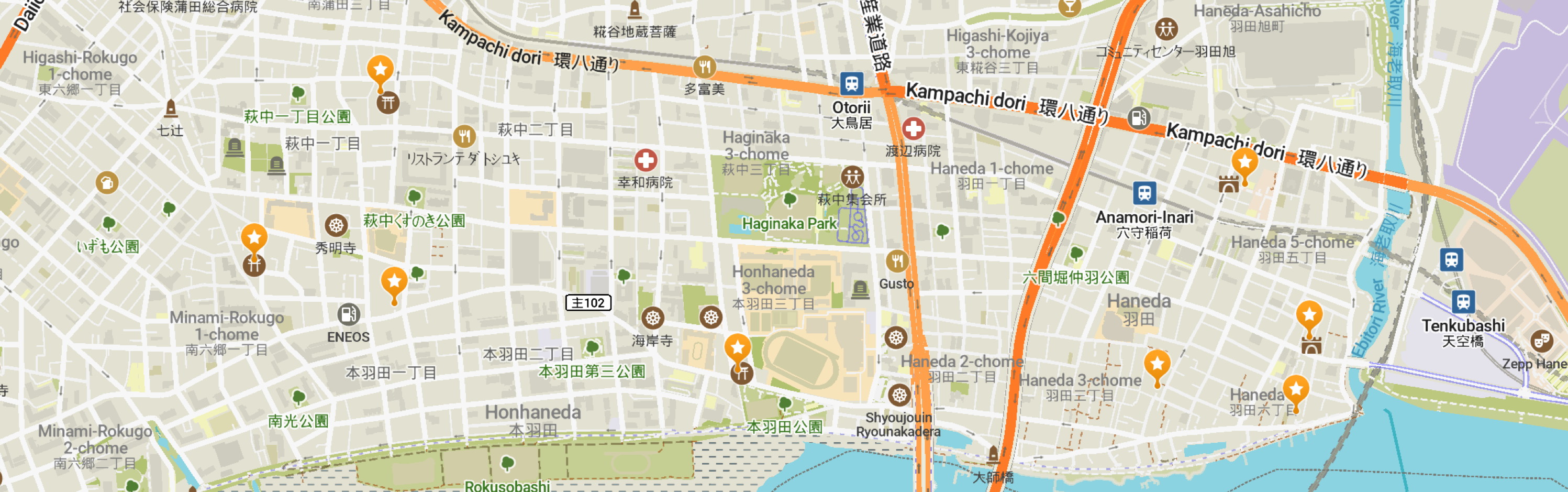
Haneda Shichifuku Inari Meguri / Haneda Seven Lucky Inari Pilgrimage (羽田七福いなりめぐり)
The dates for this pilgrimage are January 1st to 3rd, 9:00 AM to 3:00 PM..
Walking Distance: Approximately 5 km.
This pilgrimage route is to a series of Shintō shrines connected with Inari. Almost all of these are very small shrines, a few on the grounds of larger shrines. Founded in January Shōwa 63, January 1988, this pilgrimage consists of seven Inari shrines, plus an eighth extra shrine devoted to Benzaiten (Benten). Given the location on low land near a major river and Tokyo Bay several of the shrines are locations where people pray for protection from floods, historically connected with fishing, and protection from fire which was a significant hazard in earlier times.
The route you take is up to you, there is no specific sequence you have to follow.
A suggested order to visit the shrines is listed below for an easier walk. Note that the Tamagawa Benzaiten is not numbered as it is not an official shrine but often included in lists.
1. Tōkanmori Inari Shrine / Tōkanmori Inari Jinja (東官守稲荷神社)
A small shrine, Tōkanmori Inari Jinja is located in the back of the grounds of Haginaka Jinja. Originally this shrine was closer to the bay, local villager at this time both farmed and fished for a living and prayed at the shrine for safety in their work. In 1917 flooding damaged the shrine and it was rebuilt on the grounds of Haginaka Jinja. In April 1945 it was destroyed in the firebombings of WWII to be rebuilt again.
PILGRIMAGE: This shrine is on the Haneda Shichifuku Inari Meguri.
NEAREST TRAIN STATION: Kōjiya Station (Keikyū Airport Line)
2. Myōhō Inari Shrine / Myōhō Inari Jinja (妙法稲荷神社)
After floods in 1801 this shrine was established as a branch of Fushimi Inari-taisha in Kyoto Prefecture. A small shrine was built under a large pine tree under which a white snake lived so the shrine got the nickname of Hebi Inari, Snake Inari, (蛇稲荷). Both the pine tree and shrine burned down in 1923 due to the fires from the Great Kantō Earthquake. Locals built a small octagonal Buddhist building on the stump of the tree which was named Myōhō Inari, it was destroyed in the firebombings of WWII. The current building dates from 1956.
PILGRIMAGE: This shrine is on the Haneda Shichifuku Inari Meguri.
NEAREST TRAIN STATION: Kōjiya Station (Keikyū Airport Line)
WEB: NNN-Link
3. Shigeyuki Inari Shrine / Shigeyuki Inari Jinja (重幸稲荷神社)
This shrine was constructed by villagers to pray for good crops and protection from flooding. At that time the Tamagawa was next to the shrine, the course of the river has shifted over time. A camphor tree said to have been 400 years old used to be on the shrine grounds but it was destroyed in an April 1945 air raid. This shrine is also sometimes referred to as Juko Inari Jinja.
PILGRIMAGE: This shrine is on the Haneda Shichifuku Inari Meguri.
NEAREST TRAIN STATION: Kōjiya Station (Keikyū Airport Line)
4. Takayama Inari Shrine / Takayama Inari Jinja (高山稲荷神社)
Located in Honhaneda 3 Chome the shrine was originally in another location in the same neighborhood. In 1929 repair work on the Rokugō embankment resulted int he shrine being moved to the current location. The shrine's name is said to come from the carpenter who built it being from Hida Takayama.
PILGRIMAGE: This shrine is on the Haneda Shichifuku Inari Meguri.
NEAREST TRAIN STATION: Ōtori Station (Keikyū Airport Line)
5. Kamome Inari Shrine / Kamome Inari Jinja (鴎稲荷神社)
The inscription at the torii for this shrine has a date of the second year of the Kōka era (1845), this is interpreted to mean the shrine was established before that date. The shrine was built for protection from flood, fire, and disease. Legend says that when fishermen prayed here they would see flocks of seagulls indicating there would be a good catch, hence the name of the shrine as kamome means seagull the name can also be translated as Seagull Inari Shrine. The shrine was rebuilt in 1924, it was destroyed in the bombing raids of 1945 and rebuilt. The first Horse Day of the year in the old lunar calendar is special at inari shrines and at this shrine drums are beaten and bonfires lit.
PILGRIMAGE: This shrine is on the Haneda Shichifuku Inari Meguri.
NEAREST TRAIN/SUBWAY STATION: Anamori-inari Station (Keikyū Airport Line)
Tamagawa Benzaiten (玉川弁財天)
It is unsure when this shrine was founded but evidence is that a Benten-sha, Benten shrine, was in this area for some time. There was a Benten-sha established at one time in the area where Haneda Airport is now when the land was developed for rice growing. The Edo Meisho Zue (Illustrated Guide to Famous Places of Edo) has an entry for the Haneda Benzaiten south of Haneda village at the end of a sandbar. It states the shrine was moved to this location in 1711 and that a stone lantern was a landmark for ships on the bay at night. After the end of World War II the GHQ of the occupying forces requisitioned the airport in 1945 and the Benten-sha was relocated in September of that year to the present Tamagawa Benzaiten Jinja.
PILGRIMAGE: This shrine is not part of the official list of shrines on the Haneda Shichifuku Inari Meguri but is often included.
NEAREST TRAIN/SUBWAY STATION: Anamori-inari Station (Keikyū Airport Line)
6. Shirauo Inari Shrine / Shirauo Inari Jinja (白魚稲荷神社)
The dates of the founding of this shrine are unknown, however the fishing village it was in was founded in the late 17th century so that time period is possible. The shrine is popular with fishermen and the name is likely due to a custom of the fishermen making offerings of Japanese icefish, shirauo, from the season's first catch. A main purpose of the shrine is considered to be protection from fire. As the shrine was not burned down in WWII it is considered effective against fires. The current main hall dates from 1967.
PILGRIMAGE: This shrine is on the Haneda Shichifuku Inari Meguri.
NEAREST TRAIN/SUBWAY STATION: Anamori-inari Station (Keikyū Airport Line)
7. Anamori Inari Shrine / Anamori Inari Jinja (穴守稲荷神社)
Founded by Suzuki Yagoēmon in the early 19th century to help protect the local villagers against floods caused by levee breaches. The original location was within what is now Haneda Airport, after WWII the shrine was relocated when the airport was expanded. The shrine became popular due to a story of a man being healed there, so popular that train line to Shinagawa was originally established to carry people going to the shrine. The Anamori Inari is considered a good one for aviation and travel safety.
PILGRIMAGE: This shrine is on the Haneda Shichifuku Inari Meguri.
NEAREST TRAIN/SUBWAY STATION: Anamori-inari Station (Keikyū Airport Line)
EVENTS: In late August there is a lantern festival with around 300 illustrated lanterns displayed.
ACCESS: Enter the grounds from the east (main entrance), west or south sides.
WEB: http://anamori.jp/
Back to the Tokyo Stroll Supplement home page - Privacy Notice - Back to Gilles' home page
Created August 28, 2026 | Content last updated August 28, 2026