
Tokyo Stroll Supplement: Ōme Shichifukujin Meguri / Ōme Seven Lucky Deities Pilgrimage
For information on Tokyo Stroll and this web supplement see Tokyo Stroll Supplement home page
For users of the Organic Maps, Maps.Me and Google Maps apps the items below have bookmarks you can import into those apps to make navigation easier.
Instructions and links are on the Viewing Locations in Organic Maps, Maps.Me, Google Maps, or Google Earth page.
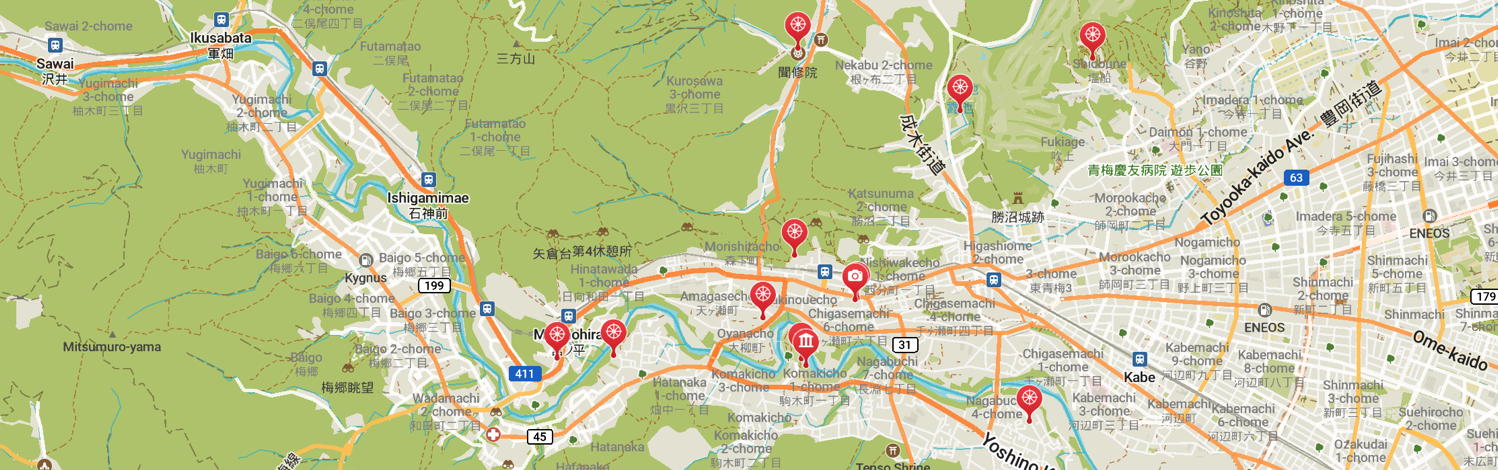
Ōme Shichifukujin Meguri / Ōme Seven Lucky Deities Pilgrimage (青梅市 七福神 めぐり)
This pilgrimage can be done Year-round depending if the temple or shrine office is open 8:00-16:00. For this pilgrimage you can get any of several designs of a paper print to be stamped, figurines of each of the deities with a stand, or a large ema with images to be stamped at each location. This is a relatively new pilgrimage founded in 1980.
Walking Distance: Approximately 20 km.
The route you take is up to you, there is no specific sequence you have to follow. This page is just a quick list of the pilgrimage locations. For this reason I may also include links in the entries below to more information on the locations.
Enmeiji (延命寺)
Founded in 1369 by a Zen monk this temple has the distinction of having never burned down in its long history. The main image of the temple is Shaka Nyorai and the main hall has some lovely ornate carvings here and there. During the Taishō Period (1912-1926) renovations added 269 painted ceiling panels with images of birds, landscapes, and flowers based on various famous poems. These were painted by 43 painters including such famous artists as Murata Tanryō, Otake Etsudō, Komuro Suiun, and Tanaka Anzanshi. In 1934 a five story wooden pagoda was added, Yakuyoke Kannon is enshrined in the pagoda and people pray here for protection from disaster. The grounds include Ōme Tenjin Shrine where people pray for academic success, there is a rare stone statue of Inui-Datsubaba, and Sumiyoshi Myōjin is enshrined as the guardian of the temple gate. There is also a hall devoted to Donryu shōnin, an early Edo Period monk who took in poor and abandoned children and raised them. People pray here for safe childbirth and successful child-rearing. Daikokuten of the Seven Lucky Gods is also enshrined at the temple.
FESTIVALS: The monthly temple festival is on the 8th, with the festival in April being the grand festival.
PILGRIMAGE: This temple is on the Ōme Shichifukujin Meguri route for Daikokuten.
NEAREST TRAIN/SUBWAY STATION: Ōme Station (JR Ōme Line)
WEB: http://ome7.tokyo/enmeiji/
Gyokusenji (玉泉寺)
A Zen Buddhist temple founded in the Bunpō Era (February 1317 to April 1319) by Prince Morikuni, ninth Kamakura shōgun, and the Zen monk Kokuichi Zenshi Taiko Seigen Osho. The temple has suffered from many fires over the years. The main building was rebuilt in 1995. The main image is of Eleven-Headed Kannon. On the grounds there is the Aoishitōba, a stone tablet dating from 1288 inscribed with the Sanskrit character for the Amida Sanson. The tablet is the oldest of its kind in Ōme and is designated as a cultural property of the City. The temple also has a natural spring and pond in the garden next to the Benzaiten hall. The present moss and stone garden dates from 2018 and was designed by the husband and wife team of Fukatsu Shintarō and Horiuchi Chie of the Niwasho Fugen company. The couple studied in Kyoto under the master gardener Kitayama Yasuo.
PILGRIMAGE: This temple is on the Ōme Shichifukujin Meguri route for Benten.
NEAREST TRAIN/SUBWAY STATION: Higashi Ōme Station (JR Ōme Line)
WEB: https://ome-gyokusenji.tokyo
Jizōin (地蔵院)
Founded in 1504 during the Bunmei Era (April 1469 through July 1487), in the An'ei era (November 1772 through March 1781) the main hall was rebuilt. The hall is called the Gokakudō as according to legend when the roof-laying ceremony was taking place five cranes flew up. The thatching on the roof was replaced with copper plates in 1977. The main gate of the temple is believed to date from the early 17th century. The original thatched roof has been replaced with copper plates. The main image is that of Jizō Bosatsu. There is also a statue of Hotei on the temple grounds in it's own small subtemple. Originally this statue was housed in the main hall next to the main image. Ashikaga Yoshiteru, the 13th Ashikaga Shōgun, donated to the temple as did Tokugawa Iemitsu, the 3rd Tokugawa shōgun. A rare variety of plum tree can be seen on the temple grounds which has bright red stems and sepals and white flowers. This particular tree is called the Hōju plum tree. The tree is sometimes referred to as the Garyū plum tree, Garyū means reclining dragon. There is also a natural spring on the grounds that has never stopped flowing, you can see freshwater crabs and snails in the water.
PILGRIMAGE: This temple is on the Ōme Shichifukujin Meguri route for Hotei.
NEAREST TRAIN/SUBWAY STATION: Ōme Station (JR Ōme Line), or take the bus and get off at the Hatanaka Jinja-mae stop.
Meibakuin (明白院)
Founded in 1567 and rebuilt shortly later in 1570. The gate of the temple is in the Kirizuma style and dates from the Azuchi–Momoyama period (1568 to 1600). This gate has been designated an Important Cultural Property of Ōme. It was not originally here but moved to this location in the Edo Period (1603–1868). The main image of the temple is of Shōgun Jizō, a version of Jizō that protects soldiers in battle and is usually depicted dressed in armor. On the grounds you will see the shōfuku no tanuki, a statue of a tanuki carrying a bale of rice. The story goes that a monk found the body of a tanuki along with rice and three small Fukurokuju figurines in the ceiling of a room. The statue was made as a memorial to pacify the spirit of the tanuki.
PILGRIMAGE: This temple is on the Ōme Shichifukujin Meguri route for Fukurokuju.
NEAREST TRAIN/SUBWAY STATION: Miyanohira Station (Ōme Line)
Monshūin (聞修院)
A Zen Buddhist temple founded in the Tenbun Era (July 1532 through October 1555) by local resident Kurosawa Kuranosuke and the 3rd head monk of Tenneiji. In 1655 Tokugawa Iemitsu gave land to the temple to help support it. After two major fires a couple of years apart most of the temple burned down, the current main hall was dates from 1850 and many other buildings were rebuilt in the Meiji Era (October 23, 1868 - July 30, 1912). The main hall has a thatched roof in the style of a kayabuki farmhouse, the current roof was re-installed from 1999 to 2003 as thatched roofs have to be periodically replaced. The main statue, located in the center of the main hall, is of Amida Sanson, a triad of images consisting of Amida Nyorai, Kannon Bosatsu, and Seishi Bosatsu. This Amida Sanson dates from the mid-Kamakura Period (1185–1333) and is designated as a “Cultural Property of the City of Ōme. Records indicate it was given to the temple by the powerful Hōjō clan. Next to this is a statue of Jurōjin one of the Seven Lucky Gods. The temple has forested grounds next to the Kurosawa river and includes a spacious garden with a stream and koi pond, local deer sometimes come into the garden which is appropriate as the deer is associated with Jurōjin.
ACCESS: The main entrance is to the south east of the temple.
PILGRIMAGE: This temple is on the Ōme Shichifukujin Meguri route for Jurōjin.
NEAREST TRAIN/SUBWAY STATION: Ōme Station (JR Ōme Line) From here take the Tōei #74 bus to Kurosawa and get off at the Yanagawa bus stop. From there walk south to the temple. Do check the maps for the best walking route.
WEB: http://www.monsyuin.org/
Seihōin (清宝院)
No records of when this Shingon Buddhist temple was established have survived due to fires. We do know it was originally it was called Aoyagiyama seihōin, in the Genroku Era (September 1688 - March 1704) it was rebuilt and restored. During the Bunsei Era (April 1818 - December 1830). The main gate was originally at Guncharimyōō Jizōin Kōenji Temple in Iruma City in Saitama and is believed to have been built near the end of the 18th century. The gate was moved to Seihōin in the late Edo Period. The main statue of the temple was transported from Naritasan Shinshōji after being divided into sections, carried to Seihōin on horseback and then reassembled. There also is an Ebisu statue here which is especially worshipped by woodworkers. One interesting legend is that is you go by the slope on the east side of Seihōin you may meet an ugly old woman who only has the upper half of her body. This is the Mujina Babaa, mujina is another word for tanuki, babaa is an insulting form of the word baba, old woman, this apparition is doubly spooky as it is said to be that of a dead tanuki.
ACCESS: The entrance is on the south
PILGRIMAGE: This temple is on the Ōme Shichifukujin Meguri route for Ebisu.
EVENTS:
February 3rd is Setsubun where beans are scattered to repel demons and bad luck.
August 15th has an event where yamabushi perform rituals and firewalking
NEAREST TRAIN/SUBWAY STATION: Ōme Station (JR Ōme Line)
WEB: https://ome7.tokyo/seihouin/
Sōkenji (宗建寺)
The date of the temple founding is unknown, Sōkenji was originally a Jōdo-shū temple it was soon changed to a Rinzai Zen temple. The main image of the temple is a statue of Bishamonten, there is another statue of Bishamonten in the temple with a signature that indicates it was made by Kūkai. This statue is only shown to the public in January.
LOCAL DETAILS:
Shomen Kongō Kōshintō: South of the Benten pond you can see a rare type of round Kōshintō.
Urajuku Shichibee's grave (裏宿七兵衛の墓石): Shichibee was a farmer who would steal from the well to do merchants and samurai and share with those in need. He was eventually caught and executed north of Sōkenji, a local monk performed rites for him and established his grave. Nakazato Kaizan included him as a character in his book Daibosatsu Tōge, "Great Buddha Pass" which was made into the films Satan's Sword (1960) and The Sword of Doom (1966).
Azuki-babaa: A local legend speaks of the Azuki-babaa, the old woman who washes azuki beans. The sound of her doing this is said to be heard in a small stream to the east of the temple.
ACCESS: The entrance is from the east.
PILGRIMAGE: This temple is on the Ōme Shichifukujin Meguri route for Bishamonten.
NEAREST TRAIN/SUBWAY STATION: Ōme Station (JR Ōme Line)
WEB: https://soukenji.com/
Back to the Tokyo Stroll Supplement home page - Privacy Notice - Back to Gilles' home page
Created August 14, 2024 | Content last updated August 23