

Tokyo Stroll Supplement: Collecting Goshuin at Shrines and Temples.
More non-Japanese are starting to collect goshuin these days so I have written this essay to help travelers understand what they are getting into.
What are Goshuin?
Goshuin are stamps recording a visit to pay respect to the deities at a Buddhist temple or Shintō shrine. Sometimes there is a special location on the grounds just for requesting goshuin. Not every location offers goshuin due to a shortage of staff or other reasons so just enjoy the grounds. At the temple or shrine calligraphy will be usually handwritten in black ink, and sealed in red with a special stamp, or stamps, creating the goshuin. Details commonly written are the name of the shrine or temple, the principle deity, the date, and perhaps additional text related to the location. Some locations may have special goshuin related to the season or the religious calendar.
Where do you keep your goshuin?
The most common way to keep your goshuin is by using a goshuinchō. These are blank books in which the goshuin is written and stamped. Goshuinchō usually come in one of two sizes: 110 x 160 mm (4.33 x 6.3 inches) or 120 x 180 mm (4.72 x 7.09 inches). The most common style is accordion binding, this allows the book to be opened so both sides are visible. It is best to assume you will need a goshuinchō to get the goshuin.
Where to get goshuinchō?
The easiest place is at a medium sized or larger shrine or temple. I bought my first one in Asakusa at the Yōgōdō Hall at Sensōji for Buddhist temples, and my second one at Asakusa Shrine for Shintō shrines. You can also buy them at stationary stores and some tourism offices. The quality at commercial sellers varies as some have thinner paper so you can only use one side due to ink bleeding through. There are also extra small ones which may not be accepted by some locations. There are even stores that specialize in making and selling goshuinchō such as Miotsukoshi Yokochō Ningyōchō (https://miotsukushi-yokocho.com/) in the Ningyōchō neighborhood of Tokyo. All the ones I have seen from shrines and temples are good quality.
What about preprinted goshuin?
Be aware that some goshuin are preprinted on separate slips of paper exist. These are usually for particularly busy times or locations that lack enough staff to do them individually. These are called kakioki "already written," details such as the date etc. are usually added by hand at the time of purchase. While kakioki commonly have an image or text printed on the paper some locations may have staff do them entirely by hand in advance on blank slips of paper.
What about large format goshuin?
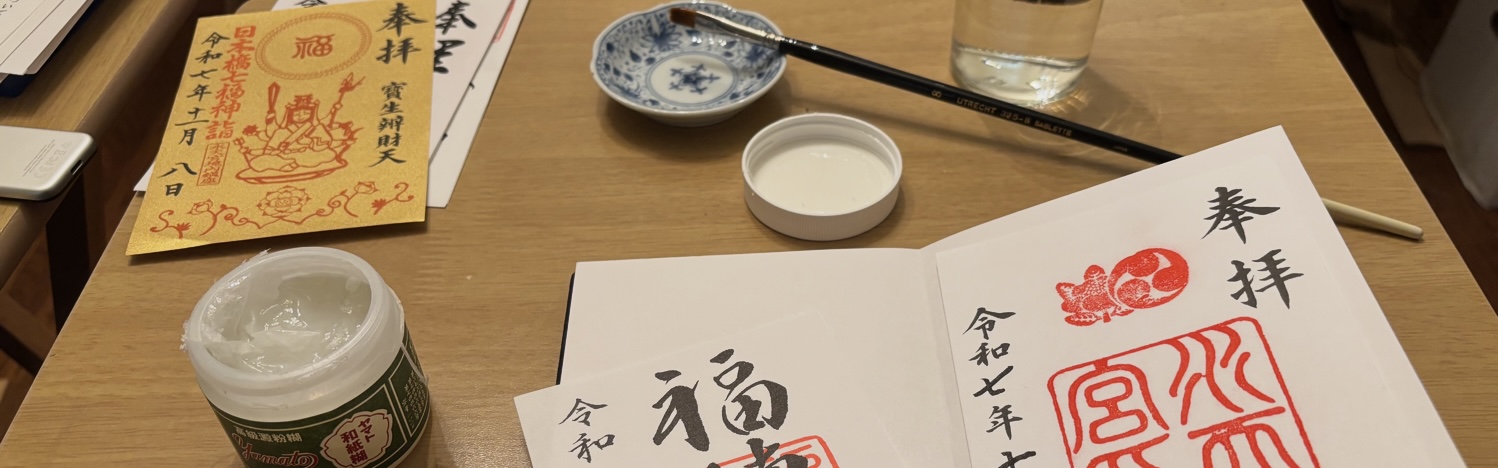
There are also large sized preprinted goshuin which require a larger goshuinchō, some of which have clear pages to slide them into so glue is not required. These goshuin are elaborate, at times to the point of tacky in my opinion. You may also want to frame some of the ones you get.
What about glueing in preprinted goshuin?
I strongly advise against using most adhesives. Tape, dots, stick adhesives, common paper glues can all damage the goshuin and book over time due to chemical reactions with the paper. This is why old scrapbooks often have yellow blotches and decayed paper on many pages. Instead it is best to use an archival plant based adhesive. One of the best which you can order online is Yamato Nori starch which comes in tubes or in jars. I prefer the jar as you need very little applied thinly to prevent any warping of the paper from moisture. I use a narrow artist's paint brush to make a small square in the upper two corners. You can easily straighten the goshuin if you need to before the glue sets. Close the goshuinchō and perhaps put a book on top to keep the goshuin flat as the glue dries. NOTE: Make sure you glue them in right side up.
Other ways to gather goshuin for pilgrimages.
Ways to collect goshuin for a specific pilgrimage route include: on a paper print with images for each pilgrimage site, or a shikishi which is a square stiff white paper board also usually with images. At each location calligraphy and the stamp will be added. A scroll can also be used depending on the pilgrimage. For some large pilgrimages they may even add the calligraphy and stamp directly on a pilgrim's robe. All these non-goshuinchō forms of pilgrimage site collection are best left to those who are prepared to make extra efforts. Of course you can still just use your goshuinchō.
Etiquette
- This is very important! Other stamps do not go in a goshuinchō!
- Pay respect at the temple or shrine to the deities before going to get your goshuin. A goshuin is a record of having done so, it is not just another souvenir. In fact some consider it disrespectful to give away a goshuinchō as it is a personal document.
- Shrines and temples are not souvenir shops, don't interrupt staff doing other duties.
- If there is a line wait quietly for your turn, do not attempt to chat with busy staff, do not take photos without permission.
- Have cash and correct change, keep a good stash of 500 and 100 yen coins in a handy coin purse.
- If you are using a goshuinchō open it to where the stamp goes and present it in both hands with the goshuinchō facing the staff member. Some large busy places may give you a number to be called, in Japanese, when your goshuin is ready or tell you to come back after awhile.
- You may want to have separate goshuinchō for Buddhist temples and Shintō shrines. This will rarely happen but some staff may take offense at mixing the two and may not stamp your goshuinchō. I keep three, one for Buddhist temples, one for Shintō shrines, and one for places where Benzaiten (Benten) is worshiped as she is found both in temples and shrines.
- Notes:
Some Nichiren Buddhist temples will only stamp a goshuinchō that is reserved for their tradition.
Most Jōdo Shinshū temples do not do goshuin. - And remember, other stamps do not go in a goshuinchō.
Further, and highly recommended, reading:
The chapter "Pilgrim Stamps" in the book Occult Hunting and Supernatural Play in Japan by Laura Miller.
Back to the Tokyo Stroll Supplement home page - Privacy Notice - Back to Gilles' home page
Created October 22, 2026 | Content last updated October 22, 2026